Non-binary Identity and Gender Stereotypes: What You Need to Know
Countries that recognize a neutral gender or a third gender on civil registration records include Australia, Canada, Argentina, the United States, Nepal, and Pakistan. In addition to providing greater recognition for intersex people, this option also acknowledges non-binary people.
While the French government recognizes only two genders, the pronoun “iel” was added to Le Robert in 2021, and more and more organizations are committed to the protection and inclusion of LGBTQIA+ people in the workplace. From including pronouns in email signatures to adapting workplace facilities (such as installing gender-neutral restrooms), the issue of gender in the workplace is increasingly being taken into account and better understood.
However, non-binary gender remains a little-known aspect of gender identities, as do the manifestations and effects of the gender stereotypes associated with it. In this article, the AFMD offers an overview of the topic.
Non-binary spectrum: What Is It?
Gender binarity is the assumption that there are strictly only women and men. However, the concept of non-binary gender refers to a broad spectrum of gender experiences and identities that fall outside and/or at the intersection of femininity and masculinity.
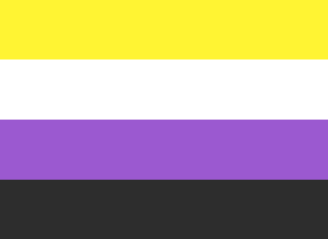
To better understand these concepts, we can take a closer look at the non-binary flag. It consists of four colored stripes (from top to bottom): yellow, white, purple, and black. Did you know that each color has a specific meaning?
- Yellow represents people whose gender exists outside the binary framework
- White represents people who identify with several or all genders
- Purple represents people who fall between the male and female genders
- Black represents people who are genderless or gender-neutral
Non-binary Identity and Gender Stereotypes: How Do They Manifest?
Non-binary identity challenges gender norms and performance expectations. It goes against the pressure to conform to a binary system. As shown in the diagram below, non-binary identity is a spectrum that lies at the intersection of gender expression and gender identity.
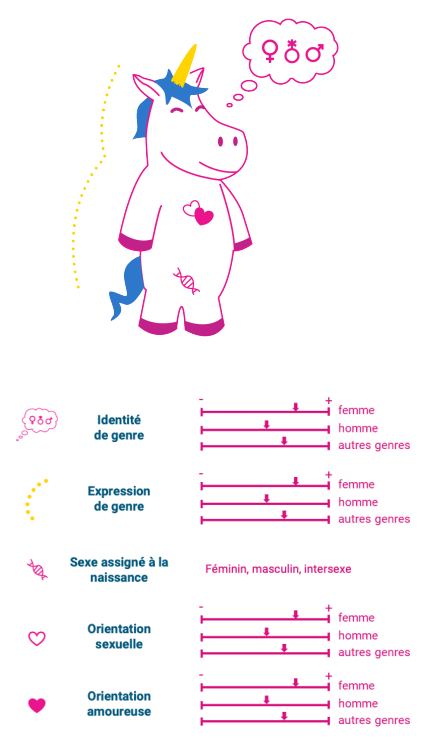
The illustration of the “gender unicorn” is taken from the e-learning course “Recognizing and Addressing LGBTIPHOBIA in the Workplace” by SOS Homophobie and is adapted from the transstudent.org website.
Gender stereotypes hinder our understanding of the very concept of gender.
As we saw in our book, “Gender Stereotypes and Professional Values: Do Students at the Grandes Écoles Share the Same Ambitions?” Jean-Baptiste Legal and Sylvain Délouvée define stereotypes as a set of beliefs about individuals or a group of individuals that are “generally socially shared in the sense that they are conveyed and perpetuated by the social environment (family, friends, media, society).” Because of their systemic and pervasive nature in society and the binary expectations they reinforce, gender stereotypes are sources of prejudice, but also the root causes of violence.
Indeed, when discourse biased by gender stereotypes takes on an essentialist tone (that is, when it demands and assumes consistency and alignment between biological characteristics, behaviors, and gender identity), this can lead to erroneous judgments, which form the basis of a continuum of violence (Kelly, 1987) and have serious consequences for LGBTQIA+ people.
For example, transgender people face transphobia particularly often, and this situation is not improving over time. In fact, “the 2023 SOS Homophobia report on LGBTIphobia notes a 35% increase in the number of cases of transphobia (rejection, insults, discrimination, physical assaults, etc.) recorded for the year 2022 compared to the two previous years.” It is important to note that this violence particularly affects trans women of color, as demonstrated by the statistics from the “Trans Murder Monitoring 2023 Global Update.”
These gender norms have an impact on those who do not conform to them. In the case of non-binary people, gender stereotypes manifest themselves through two main expectations:
- The pressure to conform to a binary gender identity and expression. Non-binary people are often told to “make a choice” and fully adopt either a male or female identity, without acknowledging their fluid gender identity or identity outside the binary.
- The expectation to educate others. Non-binary people are often faced with situations where they must justify themselves to others and demonstrate patience and a willingness to educate. Non-binary people are not responsible for teaching gender identity to every person they meet. Numerous resources exist and are easily accessible online (and some are listed in this article!).
Note: The call for education affects all oppressed groups, such as people of color, lesbians, and people with disabilities.
The Concept of “Passing”: Is Androgyny the Only Option?
The Représentrans association defines the term “passing” as “the act of ‘passing’ or being perceived, in the eyes of others, as a member of a gender in which one was not raised from birth.”
This concept is often associated with the way a person presents their appearance, behavior, and gender expression to align with their actual or desired gender identity.
For non-binary people, who do not identify exclusively as male or female, “passing” can be particularly complex. Because of social expectations based on gender binarity, non-binary people may feel pressured to “perform” androgyny or a “neutral” gender, as illustrated by this personal account:
As a non-binary person, exploring androgyny gives me a sense of alignment, satisfaction, and authenticity. Yet I still appreciate so-called feminine traits just as much—clothing perceived as feminine, makeup... It’s a contradiction that isn’t so absurd; gender expression can be fluid and varied, and I don’t need to limit myself to a single category.
In reality, you don’t need to “pass as androgynous” to be non-binary: there’s no right or wrong way to be non-binary—on the contrary, that’s the whole point of exploring gender. So it’s entirely possible to have a feminine or masculine gender expression while being non-binary. It would be a gender stereotype to say otherwise, wouldn’t it?
Addressing Non-Binary Identity in the Workplace
There are many issues related to gender identity in the workplace. When it comes to non-binary identity, considerations may include the use of pronouns (for example, you could make it standard practice to include them on name tags or in email signatures), workspaces (do your offices have gender-neutral restrooms?), or gender expression (what are the dress codes; are uniforms unisex, etc.).
To better include non-binary people and other members of the LGBTI+ community in the workplace, you can consult the LGBTI+ Inclusion Kit for the Workplace.
The Ally Memo
Recognizing non-binary identities and being an ally starts with small things:
Avoid intrusive or ignorant questions and comments, such as: “Were you born a girl or a boy?” or “You identify as non-binary, but you look like a girl, so I’ll treat you as one,” because they are inappropriate.
Do not mock or stigmatize non-binary people; avoid derogatory gestures or comments about them.
Avoid jokes intended to ridicule non-binary identity, such as: “You’re neither a man nor a woman? Well, I’m a helicopter.”
Do not deny the experiences or feelings of non-binary people. Do not say, for example, that “non-binary identity doesn't exist.”
Be mindful of the pronouns used by non-binary people. Each person may have different pronouns. If necessary, ask the person which pronouns they prefer.
Don’t hesitate to speak up if you witness discriminatory behavior or remarks. For example, clearly express your disagreement by saying, “I think what you just said is insensitive and discriminatory toward non-binary people.”
Use inclusive language to always acknowledge the possibility of genders other than female and male. For example, use phrases such as “ladies, gentlemen, and other guests.”
To take your role as an ally further, share informative resources and raise awareness about the experiences of non-binary people. Also, take the time to incorporate this topic into both professional and personal conversations.
Resources:
- AFMD, SOS homophobie, (2022) Kit d’inclusion des personnes LGBTI+ au travail
- E. Brown, A. Debauche, A. Mazuy (2021) Genre et continuum des violences. Collection : Grandes Enquêtes
- J. Legal, S. Délouvée (2021) Stéréotypes, préjugés et discriminations, Dunod «Les Topos»
- L. Kelly (1987) « The Continuum of Sexual Violence », dans Women, Violence and Social Control. Atlantic Highlands, Humanities Press International
- R. A. Briggs and B. R. George (2023) What Even Is Gender? Abingdon, Oxon: Routledge
- TGEU (Transgender Europe) (2023) Trans Murder Monitoring 2023 Global Update
- Podcast : BBC Sounds : NB : My No-Binary Life
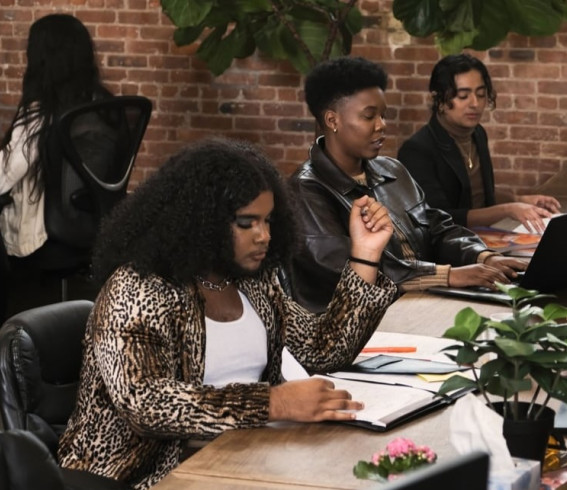
- VICE’s image library, The Gender Spectrum Collection. In 2019, after realizing that stock image libraries failed to represent trans and non-binary people, VICE created this collection of royalty-free images. The goal of the project is to encourage the representation of trans and non-binary people in the media without reducing them to their gender identity: the collection covers topics ranging from careers to leisure activities to family life. The photograph accompanying this article is from the collection.