The Inclusion Observatory (ODI)
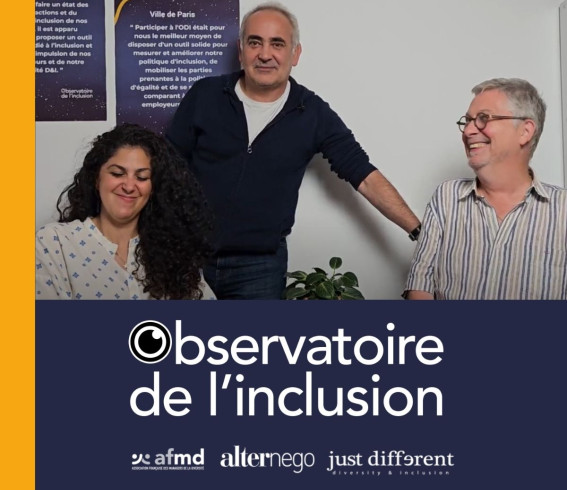
The Inclusion Observatory, created by the AFMD, AlterNego, and Just Different, is the first observatory dedicated to measuring inclusion in organizations in a transversal way. It provides a comprehensive, comparative, and transversal overview of the state of inclusion in the workplace.
What is the Inclusion Observatory ?
- A unique and innovative tool that goes beyond siloed measures and enables organizations to measure inclusion through a transversal approach
- Une mesure en miroir inédite qui permet d'évaluer les actions transversales réalisées par les organisations et de mesurer le sentiment d’inclusion des collaborateurs et collaboratrices
- Un accompagnement par trois partenaires experts que sont l'AFMD, AlterNego, et Just Different tout au long du processus
Why participate in the Observatory
- Assess your organizations: obtain transversal inclusion scores
- Benchmark your organization: see how you compare to other organizations and the national average
- Steer your Equality, Equity, Diversity and Inclusion Strategy: define progress indicators and track your performance over time
First Edition of the ODI in 2025
Participating Organizations
Ten volunteer organizations that are members of the AFMD—representing a variety of industries and sizes—participated in the first edition of the ODI.
Key Takeaways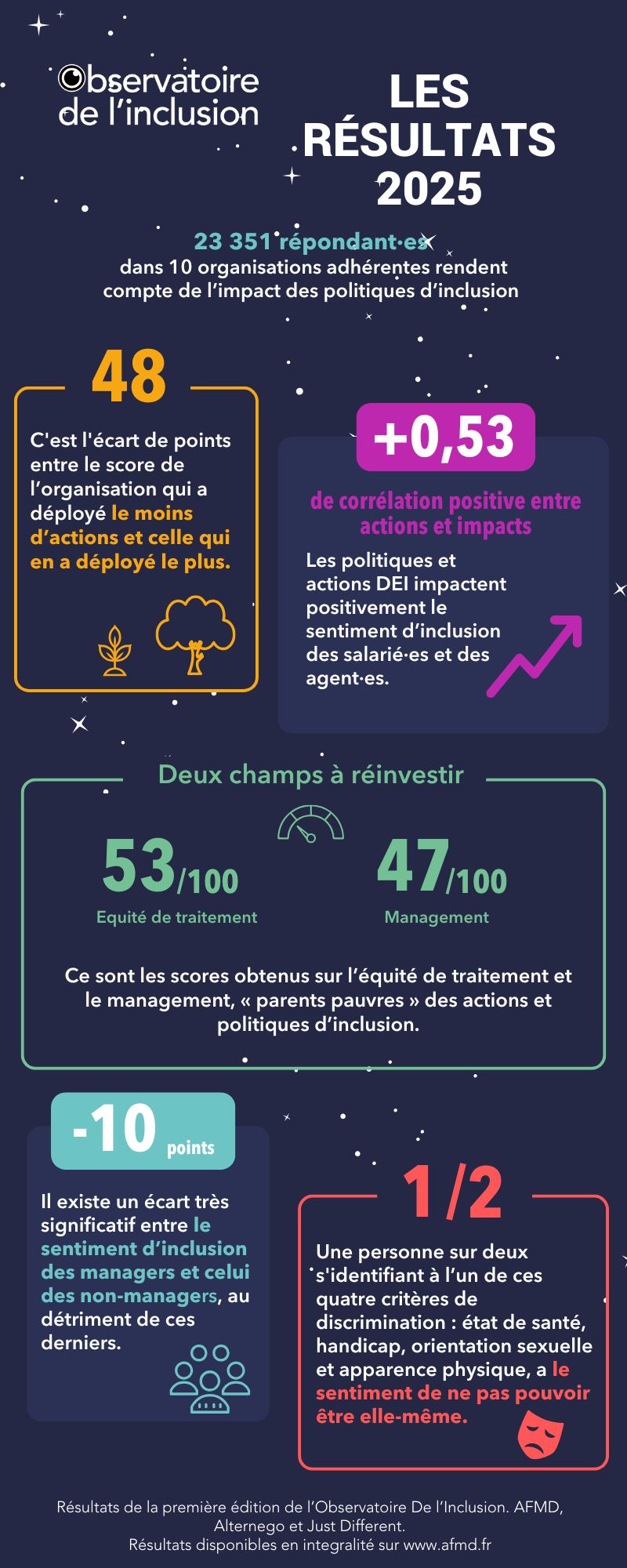
A total of 23,351 responses to a series of questions designed to assess the effectiveness of implemented inclusion initiatives were collected.
Equity: The Still-Fragile Foundation of Inclusion
Equitable treatment remains a blind spot for organizations—it is both the pillar in which organizations invest the least and the area where employees perceive the least progress, with an action and impact index of 53 out of 100.
Conversely, with a score of 61, a sense of belonging emerges as the pillar with the most positive impact. Organizations active in this area score five points above the average, demonstrating that the issue of identity is important within organizations and that they have everything to gain by making a sense of belonging a priority.
Management: The Blind Spot in DEI Policies
While governance and communication score an average of 70 out of 100, managerial actions plateau at 47—a sign that managers are not the primary target of DEI initiatives. Yet they are the ones most directly exposed to the practical consequences of team diversity.
There are significant gaps in perception between managers and non-managers across all pillars and dimensions of inclusion. For example, 70% of managers, compared to 50% of non-managers, believe that instances of discrimination within their organization are acknowledged and addressed. It therefore still appears challenging to foster an inclusive culture at all levels of the organization.
The ODI’s findings highlight six key takeaways that encourage organizations to take a fresh look at their inclusion practices. To explore them in full, please refer to the complete report.
Discover all of the ODI's findings (FRENCH ONLY)
Discover the key takeaways (FRENCH ONLY)
The Results Presentation Event
The results were presented at a unique event, the ODI Pop-Up, designed as an interactive exhibition, which brought together nearly 120 representatives from the participating organizations.
Origins of the ODI
The Birth of the Project and the Partnership: the "Inclusion" Working Group
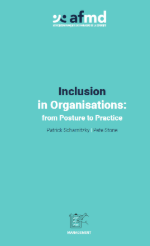
In 2016, a working group was formed with AlterNego and Just Different to define a model for inclusion in the workplace. This led to the publication of the book Inclusion in Organizations: from Posture to Practice, co-authored by Patrick Scharnitzky and Pete Stone.
In 2020, a second working group brought together fourteen AFMD member organizations to focus on measuring inclusion. In 2021, an initial version of the ODI, the Barometer of Inclusive Organizations (“the BOI”), was developed, and a beta testing phase was conducted with eight organizations.
Building on this success and these lessons learned, the AFMD, AlterNego, and Just Different launched the first edition of the ODI in 2025 to provide a comprehensive, comparative, and transversal assessment of inclusion in the workplace.
How the Observatory Works
Inclusion can be defined as the mobilisation of all diversities, through a transversal approach, in the service of individual well-being and collective performance. Its model is based on four pillars (transversality, equity, cooperation, and belonging) and four dimensions (governance, steering, management, and communication).
At a time when many tools measure diversity in silos, the ODI offers a transversal approach to inclusion—that is, one that does not question the criteria for diversity. To this end, it offers a measurement system that assesses, on the one hand, the actions taken by Chief Diversity Officers within organizations and, on the other hand, the impacts of those actions and the sense of inclusion felt by the employees of those organizations.
Measuring inclusion in your organization thanks to the ODI
You are interested in the Observatory and would like to know more about it? Feel free to contact us!