What future(s) for DEI in 2035?
Since 2024, the AFMD team has been conducting a foresight study on possible futures for DEI by 2035.

Raison d'être, Mission, Goals
For several years now, the AFMD has observed changes that call into question the scope and means of its work:
- the rise of skepticism—and even outright questioning—regarding DEI in a context of polarization in ideas, discourse, and living conditions, which increases the risk of diversity fatigue, burnout, or even self-censorship among DEI leaders;
- the growing number of actors in the DEI field, reshaping the landscape;
- concerns among DEI leaders about the future of their roles.
These trends are part of a broader French and European context of instability and inertia linked, among other factors, to the rise of the far right.
The Role of the AFMD"The AFMD, as a community and a resource center, is more than ever a key player in supporting businesses and institutions. Our mission is to inform, guide, and support government agencies, businesses, and all stakeholders in integrating the topics of DEI into their professional practices [...] Now more than ever, we must envision and build the inclusive organizations of tomorrow, taking current challenges into account while remaining open to the infinite possibilities offered by demographic, economic, social, societal, and technological changes." Delphine Pouponneau et Romain Plaisantin, presidents of the AFMD |
For these reasons, the AFMD decided to undertake a foresight project on possible futures for DEI policies by 2035 in partnership with Futuribles, whose mission is:
- to study possible developments in the sector (topics addressed, stakeholders, legislation, etc.);
- to explore the potential impacts of changes in the global context and the DEI sector;
- to identify opportunities for change, adaptation, or resilience strategies.

This initiative aims to achieve complementary, exploratory, and strategic objectives on several levels:
- the AFMD: to foster internal discussion to establish a vision of its challenges by 2035 and strengthen its unifying role in the area;
- the DEI ecosystem: to equip professionals at all levels of organizations (DEI, HR, SME leaders, etc.) and bring stakeholders together around common arguments and perspectives;
- public policymakers: to develop advocacy strategies and concrete recommendations in preparation for the 2027 French presidential elections.
Methodology
This project, which is both unifying and analytical, involves and engages the DEI ecosystem in its deliberative process. Depending on the project’s stages, the AFMD has conducted interviews with experts (researchers and employers), has launched online surveys to test its hypotheses, or brought stakeholders together in working groups.
The project is also being carried out in parallel with a quantitative and qualitative study on Chief Diversity Officers led by the AFMD’s research team.

The main steps of the project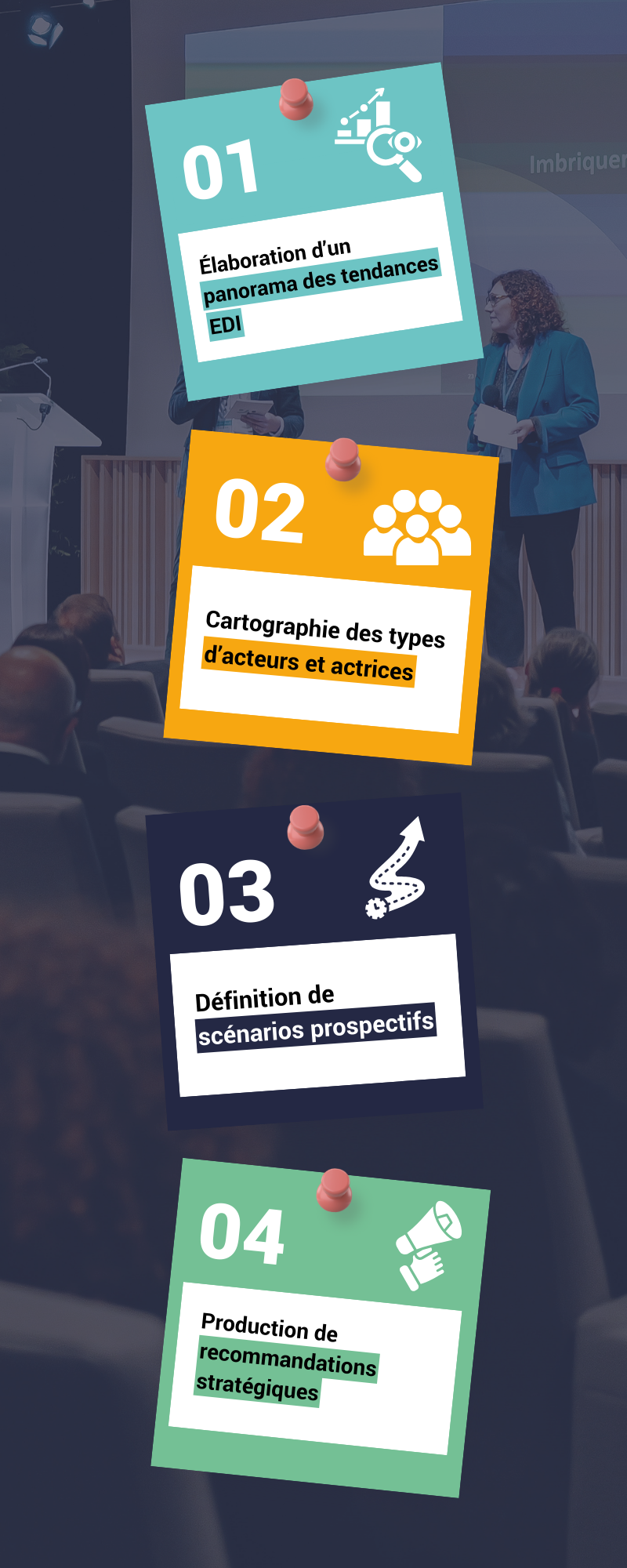
Developing an Overview of Trends
This overview, developed using the methodology described above, outlines the major trends in the global context, the professional environment and its regulation, and DEI issues and functions. It also offers insights into the impacts of these developments on EDI functions.
Based on this work, the AFMD made hypotheses and submitted them to stakeholders in the DEI ecosystem. The responses to the online survey were used to rule out certain hypotheses and to enrich the four prospective scenarios.
Read the overview Read the survey
Mapping the stakeholders influencing these trends
The AFMD has also mapped out the stakeholders who can of influence these trends, such as institutional actors (the European Union, political parties, etc.), organizations (employers, employees, etc.), spheres of influence (the media, research, etc.), and DEI stakeholders (Chief Diversity Officers, consulting firms, and organizations such as the AFMD, etc.).
Defining Scenarios
Based on the trends in the overview, the AFMD and its stakeholders developed four possible scenarios for DEI in France by 2035. The scenarios were designed as possible answers to the following question: “What is the current and future scale of attacks against EDI?”
The Development of Strategic Recommandations
Finally, this project concludes with the submission of a strategic report containing key recommendations for public authorities regarding the 2027 French presidential elections.